


Waiting on the Next Ball

Updated: 4 days ago
The Angel IR3, HALO B, and the feeding race of 2002

The year is 2002; with seemingly all the attention paid to how fast an electronic marker could cycle, there was an inconvenient little object at the center of the discussion. A paintball still had to arrive in the breech, remain intact, and be ready when the marker wanted to fire. That paintball did not care what the advertisement said and whatever snake oil the sales team concocted. If the paintball was late, the most expensive and sophisticated equipment in the staging area could quickly become a, still very expensive, Vitamix blender.
In 2002, the Angel IR3 and HALO B approached that problem from different directions. One novel design lived in the marker, the other, directly above it. Together they offer a better picture of the period than another list of advertised firing rates, because the next major development in the next technological breakthrough in paintball involved persuading separate machines to cooperate. The player wanted a continuous stream of paint. The equipment had to negotiate everything that happened before it reached the barrel. It was a delicate equation that took nearly a decade and waves of engineers to fully solve until, what in my opinion, the best system emerged, the Planet Eclipse reflective BBSS(Break Beam Sensor System).

WDP debuted the IR3 at the 2002 Diablo Mardi Gras Open, remembered for its heavy rains, with a more compact body, a striking 90 degree grip frame, and an adjustable magnetic trigger system. Its electronics included infrared communication, while its COPS system used a piezoelectric sensor to detect a paintball. A small three prong gate inside the feedneck helped prevent balls from jumping in the stack and detents helped prevent the ball from moving position when the gun was pointed at varying angles. Even the most futuristic-looking Angel had to account for a ball moving the wrong way and chopping.
WDP engineer John Rice, remembered in this story, expected improvements in loaders to eventually make anti-chop systems unnecessary. It was an understandable prediction from inside a rapidly changing industry, where the next generation of feeding equipment seemed capable of eliminating the problem entirely. It also leaves a useful wrinkle in the history; the designers building the future did not always expect the same future we eventually received.

On the loader front, the Odyssey HALO B was working on precisely that feeding equation, as well as the speed issue. Its novel drive system used a gear driven, spring-loaded cone to maintain pressure on the paintball stack. Rather than waiting entirely on gravity like every other loader at the time, it could push paint toward the breech. The spring provided a buffer between the motor and the fragile ammunition, helping the loader maintain pressure without simply crushing whatever resisted it.
This solved a major issue of non-forcefed loaders, player no longer would chop a ball in half because it bounced inside the feedneck in the breach of the marker. Although early models of the Halo struggled with fragile tournament paint, quick revisions fixed the issue.
They also were attempting to exceed current loading limits that were capped at around 11-12 balls per second by the Viewloader Revolution loader favored by pros. Markers at the time like the Intimidator, Impulse, and Angel could mechanically shoot 25+ balls per second, but until the Halo B solved the speed issue, they were limited. The Halo at release sported a 25+ ball per second advertised speed, with later V35 upgrades helping push the loader to nearly 35 balls per second.
There is something wonderfully unglamorous about these design solutions; a player saw a gun ripping through paint and heard the familiar noise of an electronic loader. Behind it was a designer worrying about a stack of gelatin balls being nudged upward by a moving bolts burst of air, a marker outshooting the gravity assisted hoppers of the time, or if the player would change their batteries. Much of the speed race depended on small problems like that, the sort that disappear from memory once someone makes them stop happening.
The IR3's appearance carried a different kind of ambition. Its frame made the whole marker look as though it belonged to a deliberate new direction for the sport, rather than another year of cosmetic changes. That could be exciting even before anyone explained what the electronics did. WDP was selling luxurious performance, certainly, but it was also selling the feeling of being close to the technology while it was still visibly changing.
Of course, the player still had to put batteries in everything, which would later be the major hurdle to solve that pushed loaders like the Spire and Rotor forward when they converted from heavy 6AA and 2 9v battery setups to drastically reduce weight and power consumption. The desire for advanced equipment came with the fairly ordinary responsibility of ensuring that both the gun and hopper were awake when the point started. Mundane, every point tasks that now feel instrictual, when some older players can still remember when the process felt foreign and new, along with the stress of the gear even working.
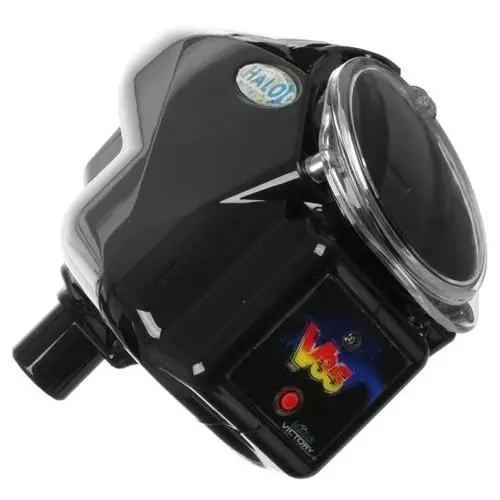
Looking back at the IR3 beside a HALO B, the interesting question is how much of the experience belonged to either product alone. The marker's ability to wait and the loader's ability to deliver were parts of the same conversation. Rice thought one side might eventually make the other unnecessary, however that problem still remains for another generation of designers. For the player walking onto the field in 2002, having both working seemed a fairly reasonable place to start.
History would disprove much of the technology that became sacred to those products. The COPS system by WDP in the IR3 would be mired with problems from the start, with many players opting to rip the system out entirely. It would be replaced in 2004 with the debut of the Angel A4 platform with laser eyes. For the Halo, its speed came with a heavy weight, awkward shell design that often cracked, and difficulty to clean the loader when it would inevitably crush a few paintballs. The Halo would eventually inspire Dye Precision to release the Dye Rotor, a hopper that revolutionized the indutry with its 3 AA batteries, softer, more durable shell, and field strip assembly allowing players to clean their hopper between points.
No matter what history may present, the IR3 and the Halo B will be remembered as cherished relics from a time when effortlessly shooting a stream of paintballs was not the assumed outcome like it is today, and when the cult religion of marker-speed dominated the pits.



Comments