


A Little Out of Time

The sound and stubborn appeal of the Autococker
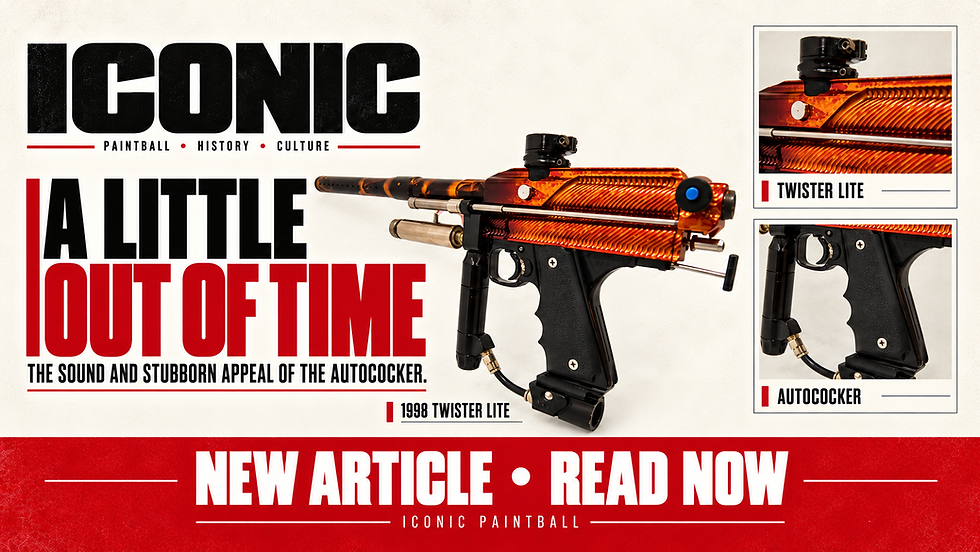
An Autococker can make a perfectly reasonable person stand beside a staging table and watch a piece of aluminum move backward and forward for considerably longer than necessary. The back block cycles, the hoses twitch, and the marker settles into that familiar rhythm. Nothing about the scene is particularly efficient. Yet for a player who understands the attraction, it is difficult to imagine a more convincing demonstration that the gun is working exactly as it should.
There is a temptation to begin every Autococker story with its eventual displacement by electronic markers. That gives the machine a strangely defensive role in its own history, as if it existed mainly to resist something that had not arrived yet. For much of its competitive life, the Autococker was the equipment top players were winning every event in the country with. It was a serious tournament platform, backed by builders and airsmiths who continued finding ways to make it their own. Before I continue, I will mention to our younger readers that a paintball airsmith was the precursor to modern paintball techs; individuals of part magic, part engineering that cobbled together some of the earliest designs in paintball. Not formally trained or test, but creative and fully of ingenuity to advance the sport.

The autocockers origins were practical. Bud Orr's WGP Sniper was a pump marker, pushed forward by the groundbreaking addition of pneumatic recocking that helped turn that foundation into the Autococker. In a 2004 WARPIG account, Orr recalled working through crude early versions before showing the design to Bob Long and establishing its connection with the original Ironmen. The familiar finished product had come out of the same environment as so much early paintball equipment: people at fields trying to solve the problems directly in front of them.
Mechanically, that heritage remained visible. The trigger released the hammer to fire, then operated the pneumatic system that moved the bolt and re-cocked the marker. Releasing the trigger returned the bolt forward. The sequence required proper timing and a complete trigger stroke, which gave the player a more direct relationship with the cycle than the light switch of an electronic frame. Short-stroking was a fairly immediate way to discover that the machine had not finished what you had asked it to do.

That relationship could be satisfying or deeply inconvenient, sometimes within the same morning. The romantic version of Autococker ownership concentrates on the moment a beautifully tuned gun feels effortless. The less photogenic version involves someone leaning over a table while the rest of the group asks how much longer it is going to take. Both belong in the history. Removing the frustration would make the affection a little harder to understand. It makes me recall a story Oliver Lang has told mentioning that his first real marker was a black autococker that seemingly never worked, but he always felt implored and inspired to use.
The platform also gave an airsmith room to leave a signature. Bodies, frames, pneumatics, and finishes could change the character of the finished marker without erasing its underlying identity. It is part of why two Autocockers can belong to the same product line and still feel like entirely different objects. One looks ready for a long day in the woods; another looks as though its owner should have brought a velvet-lined case instead of a gear bag.
Electronic conversions complicated that identity in an interesting way. Systems including the RaceGun frame and Planet Eclipse E-Blade brought electronic control to a design associated with mechanical timing. To some players, that was the natural continuation of the platform. To others, the attraction had been the trigger and the rhythm all along. The disagreement was useful because it revealed that people were buying the same machine for different reasons, even when they used the same word to describe it: performance.
I think that is where the Autococker becomes more interesting than a simple argument about old equipment being better. A marker can be slower to service, more demanding to understand, and still offer something a player wants.

Enjoyment does not have to survive a tournament efficiency audit. There is room in paintball for equipment that asks a little more of its owner, particularly when the owner is choosing the conversation.
A clean, uninterrupted string of typewriter-like shots still explains much of the appeal. You can hear the separate actions cooperating, and you can see enough of the mechanism to appreciate what is happening. Then somebody reaches for an Allen key because the trigger could probably be a little shorter and the stroke a little smoother. Whether the afternoon improves from there depends on if Chicago Aftershock pro and legendary airsmith Danny Love, or myself is holding the wrench.


Comments